
Key Takeaways
Exploring coin varieties offers a unique avenue for collectors to acquire valuable pieces at standard market prices through careful observation. Success in this field relies on understanding production processes and utilizing proper diagnostic tools.
- Master the distinction between genuine mint errors and post-mint damage.
- Acquire essential magnifying tools for detailed surface inspection.
- Utilize authoritative guides to confirm variety diagnostics and scarcity.
- Check dealer inventory and circulation finds for unidentified die varieties.
- Employ third-party authentication services for high-value or unusual findings.
Understanding the fundamentals of cherrypicking
Experienced numismatists often navigate the market by seeking undervalued treasures that others have overlooked in standard bins. These collectors apply specialized knowledge to identify unique die features that elevate a common coin’s status. This practice requires a systematic approach to inspection rather than impulsive buying.
Defining cherrypicking in numismatics
Cherrypicking is the art of identifying specific coins that possess rare structural features, allowing a collector to purchase them at the price of a more common specimen. It differentiates the savvy investigator from the casual accumulator. By recognizing the subtle markings that denote a scarce variety, you can effectively build a portfolio of significant items.
Distinguishing between mint errors and post-mint damage
A critical skill in this hobby is identifying whether a mark was formed during the minting process or through later handling. Collectors often struggle to differentiate between legitimate die features and surface-level gouges or displacement. Understanding that authentic errors are produced within the minting press ensures you avoid misidentifying simple post-mint damage as a rare find.
Essential tools: Magnification and lighting techniques
Effective inspection is impossible without high-quality optics and proper illumination to highlight surface depth. Proper magnification reveals the sharp transitions and raised metal typical of genuine minting anomalies. Consider the following utility breakdown for your inspection kit:
| Tool Type | Primary Function | Ideal Specification |
|---|---|---|
| Magnifying Loupe | Surface examination | 5x to 10x power |
| LED Task Light | Contrast enhancement | Cool white spectrum |
| Digital Microscope | Detail verification | 500x resolution capacity |
These tools form the backbone of a serious collector’s workflow, helping to evaluate rare die varieties with precision and care.
Identifying key error categories
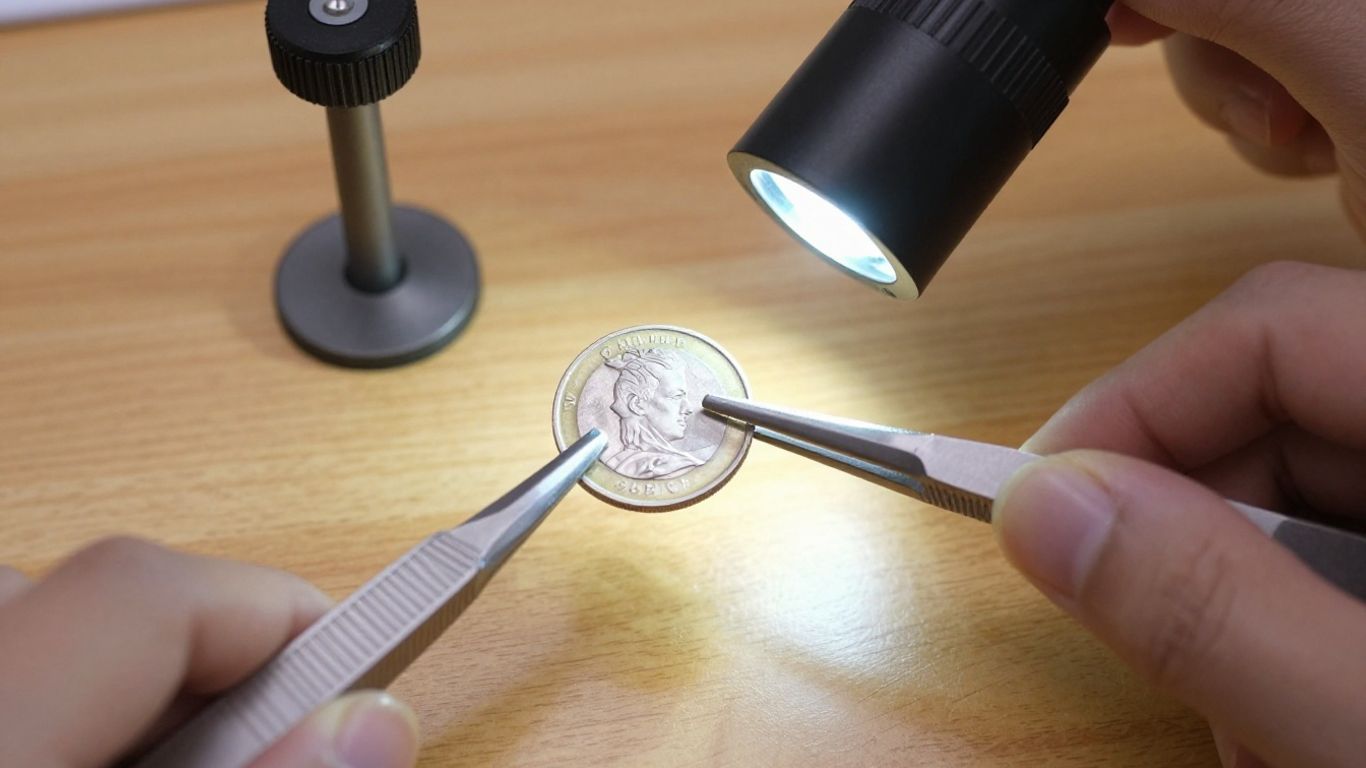
The process of categorizing minting errors allows for a more focused search strategy across different denominations. Each category leaves specific, measurable characteristics on the surface of the finished product. Collectors must understand the physical origins of these mistakes to truly grasp their value.
Planchet errors and their structural characteristics
Planchet errors originate before the blank ever reaches the striking chamber. These anomalies include flawed shapes, improper metallic compositions, or incorrect thickness. Identifying these structural anomalies requires a sharp eye, as they often manifest in ways that appear visually distinct from standard coins.
Die errors: Doubled dies and repunched mintmark phenomena
Doubled dies remain arguably the most sought-after variety for serious collectors. These occur when the hub transfers the design to the die multiple times, creating a subtle or drastic overlap in the letters and numbers. These errors demonstrate why studying coin varieties is such a rewarding endeavor for the dedicated student of numismatics.
Strike errors: Off-center and broadstrike phenomena
Strike errors occur during the actual impression if the planchet is not correctly positioned within the die collar. Broadstrikes happen when the die hits the planchet without the retaining ring, causing the coin to spread beyond its normal diameter. You should observe several factors if you believe you have found a strike error:
- Confirm the design is centered incorrectly on the blank.
- Ensure the edge features correspond to the strike movement.
- Measure the diameter to identify potential metal flow.
- Check for genuine pressure impressions rather than surface scrapes.
These findings often require careful verification against established numismatic records to confirm they are indeed manufacturing anomalies.
Understanding modern vs. classic minting anomalies
Modern minting technologies have evolved, yet human and mechanical errors still occur with surprising frequency. While classic coins are often studied more extensively, finding an error in a contemporary set can be just as exciting. Always account for the differences in minting standards when examining pieces from various decades.
Research and reference resources
Building a collection of variety coins necessitates a library of trusted documentation. Without accurate reference materials, one risks spending money on coins that lack genuine variety status. Consistent research remains the only way to stay ahead in this competitive field.
Leveraging the "Cherrypickers’ Guide to Rare Die Varieties"
The referenced guide serves as the foundational text for recognizing and valuing varieties across many American series. It provides the diagnostic images necessary to confirm that your specimen matches verified findings. Consult this text regularly to refine your knowledge of specific doubling or mintmark placements.
Utilizing online databases from organizations like CONECA
Online resources provide real-time updates and community-driven verification for new discoveries. Databases from organizations like CONECA allow collectors to cross-reference their raw finds with documented reports. Utilizing these digital repositories can drastically shorten the time required for accurate attribution.
Cross-referencing raw coins with certified known varieties
Comparison should be a standard habit for anyone hunting for hidden retail value. If a coin appears to match a known variety, cross-referencing it with high-grade, certified examples is essential. This builds a mental baseline for what a specimen is supposed to look like under standard conditions.
Sourcing potential error coins
Finding these unique coins requires patience and access to large volumes of unprocessed material. Many collectors find their most profitable items in unexpected places rather than through premium dealer stock. Look for opportunities where others might pass over the inventory.
Scouting dealer "junk boxes" and bank rolls
Dealer "junk boxes" represent a prime hunting ground for varieties that were simply traded in without attribution. Bank rolls, while time-consuming, offer the chance to find low-mintage or faulty strikes in their original, untouched state. If you find yourself needing to estimate the cost of professional services, just as one might assess what a wedding videographer costs for high-end documentation, remember that professional attribution for coins is a separate service worthy of consideration.
Navigating online auctions and estate sales
Digital auctions have expanded the reach of the cherrypicker significantly. By searching through clear auction photos, you can find misidentified items that sellers failed to properly catalog as distinct varieties. Estate sales also provide opportunities to acquire older collections that haven’t been reviewed for specific varieties in decades.
Examining circulation finds for hidden retail value
Circulation hunting is a low-cost entry point into the hobby that can yield significant returns. Keep your eyes sharp for unusual dates or lettering that deviates from the norm. Many individuals have discovered valuable error coins just by changing their focus while sorting their daily pocket change.
Authentication and valuation workflows
Once a potential variety is identified, the validation process is paramount. Authentication ensures your time and capital are not misplaced on generic errors or cleverly made fabrications. A structured workflow protects your legacy and ensures your collection maintains market-ready standards.
Evaluating the impact of rarity and condition on market value
Condition plays a massive role in the final price of an error coin. An error on a worn coin may command interest, but the same error on a pristine, uncirculated specimen can command market-leading interest. Rarity and quality must align to maximize the return on your initial investment.
Knowing when to send coins for professional third-party attribution
Professional services provide legal confidence through formal grading and variety verification. When you are confident in your discovery, third-party encapsulation removes ambiguity for future buyers. Send coins only after you have conducted thorough research and determined the potential value justifies the service fees.
Mitigating the risk of counterfeit die varieties
Counterfeiters often attempt to replicate rare doubled dies by physically scarring the surface of common coins. Always inspect the metallic flow and under-magnification appearance of any high-value variety. If the markings seem "forced" or lack the characteristic metal displacement of a struck coin, exercise extreme caution.
Preventing physical damage during intense inspection sessions
Holding a variety coin requires careful physical handling to maintain its state. Avoid cleaning your finds, as this invariably destroys value. Instead, focus on using stable, supportive surfaces and gloves to ensure your handling process does not degrade the very thing you worked so hard to find.
Conclusion
Mastering effective error coin cherrypicking strategies allows you to participate in one of the most rewarding branches of numismatics. By combining methodical observation with historical research, you can uncover pieces that exist outside the mainstream market while developing a deep understanding of manufacturing history and design nuances.
Frequently Asked Questions
Is it common for beginners to find rare varieties in pocket change?
While finding a major, high-value error is rare, many common varieties are still discovered in daily circulation by observant collectors who study specific years.
Should I clean an error coin to make its features easier to see?
Never clean a coin, as this removes original surface characteristics and significantly lowers its value and market appeal, regardless of the variety.
Does every coin with a double image count as a doubled die?
No, many coins exhibit machine doubling, which is a common form of damage that occurs during the striking process and holds little extra value.
How does the value of an error coin change by denomination?
Market value is driven by both scarcity and collector demand, meaning that some low-denomination coins can be more valuable than high-face-value pieces due to interest in that series.
Is professional grading necessary for all cherrypicked coins?
Professional grading is usually recommended for high-value varieties where certification validates the uniqueness and condition for potential future sales.
Can I use a regular magnifying glass for variety identification?
While basic magnification helps, it might not provide the clarity required to distinguish fine details, so a professional jeweler’s loupe or microscope is generally preferred.
What should I do if my local dealer doesn’t recognize a variety?
If a dealer is unfamiliar with a specific variety, seek a second opinion from a specialist or submit the coin for formal certification through a respected TPG service.