
Coin collecting can seem a bit much at first, right? All those tiny details and numbers. But really, once you get the hang of it, it’s not so scary. This guide is all about beginner coin mintmark identification, helping you see what’s really going on with your coins. We’ll go over the basics, what tools you might need, and how to actually find and understand those little marks. It’s about making sense of the small stuff that can actually mean a lot.
Key Takeaways
- Start by looking at the front (obverse) and back (reverse) of a coin to get its basic identity and story. Don’t forget the edge, it can hide details too.
- Simple tools like a magnifying glass and a coin catalog can really help you see and understand the small marks and information on coins.
- Mint marks are small letters that tell you where a coin was made. Knowing these can be important for figuring out a coin’s rarity and worth.
- Beyond mint marks, pay attention to things like the designer’s initials, how clear the coin’s design is (strike quality), and its original shine (luster).
- Practice looking at coins, compare them with guides, and be patient. Beginner coin mintmark identification gets easier the more you do it.
Understanding The Basics Of Beginner Coin Mintmark Identification
When you first start looking at coins, it can seem like a lot to take in. There are so many details on each one, and figuring out what they all mean can feel a bit overwhelming. But once you get the hang of it, you’ll see that each part of a coin tells a story. Let’s break down the main areas you’ll be looking at.
The Obverse: Identifying The Coin's Identity
The obverse is what most people think of as the "front" of the coin. This is usually where you’ll find the main portrait, like a president’s head or a national symbol. It’s the most prominent side and often gives you the first clues about the coin’s origin and type. For example, seeing Abraham Lincoln on the front tells you it’s likely a Lincoln cent. The date is almost always found on the obverse, which is a key piece of information for collectors.
The Reverse: Uncovering The Backstory
Flip the coin over, and you’re looking at the reverse, or the "back." This side often features different imagery, like buildings, animals, or symbols that relate to the coin’s theme or country. It’s here that you’ll frequently find the mint mark, which we’ll discuss more later. The reverse can also provide details about the coin’s purpose or historical context. For instance, the reverse of a state quarter shows a unique design representing that specific state.
The Edge: An Often Overlooked Detail
Don’t forget the edge! This is the side of the coin that runs around its circumference. It’s easy to overlook, but it can hold important information. Some coins have plain edges, while others have reeding (those little lines) or even inscriptions. The edge can tell you about the coin’s manufacturing process or even indicate if it’s a rare error. For example, a coin that should have reeding but has a plain edge might be a valuable minting mistake.
Essential Tools For Mintmark Discovery
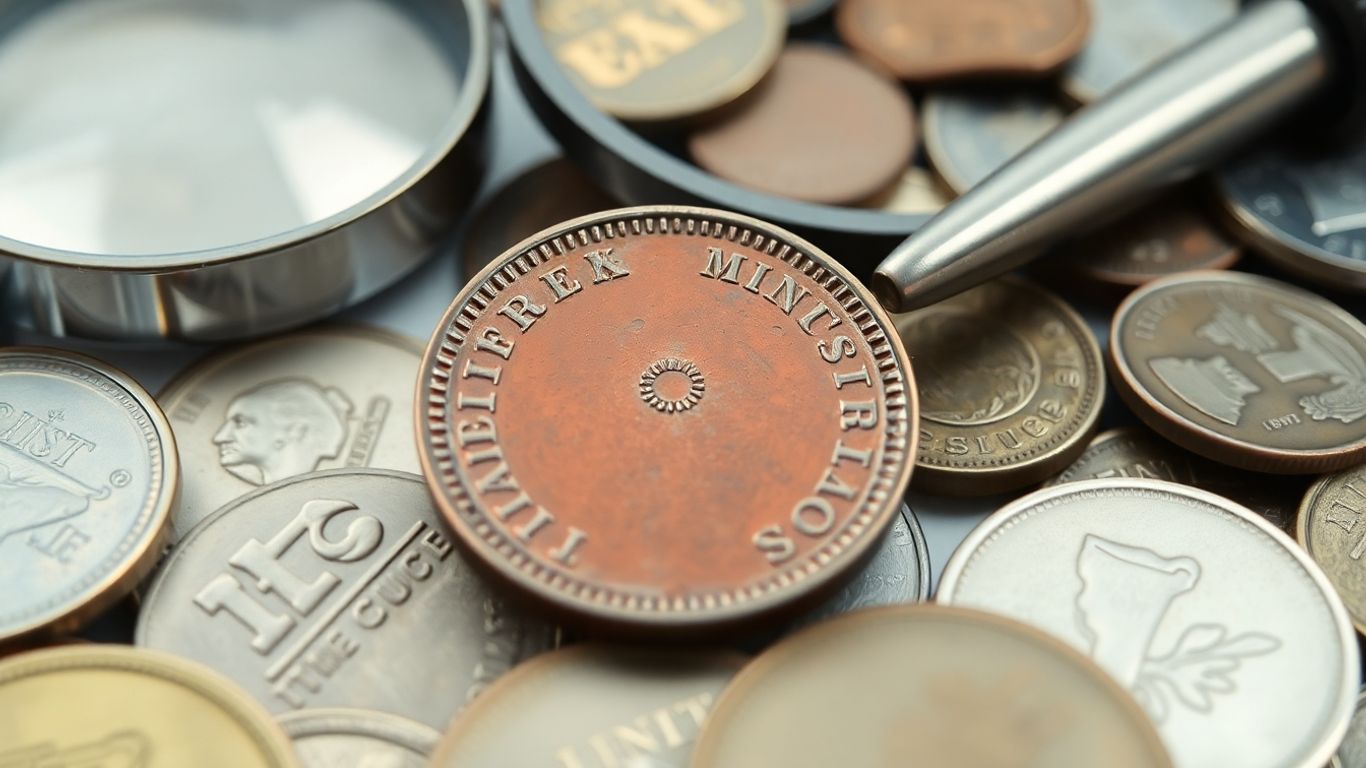
To really get into identifying mint marks and other small details on coins, you’ll want a few things. It’s not like you need a whole lab, but having the right gear makes a big difference. Think of it like trying to read a tiny label on a medicine bottle without your glasses – it’s just not going to happen easily.
Magnifying Glass: Revealing Fine Details
This is probably the most important tool. You need something that can make those tiny mint marks and other features bigger. A standard magnifying glass might work for some things, but a jeweler’s loupe, often around 10x magnification, is much better. It lets you see wear, nicks, and those all-important mint marks that are often just a small dot or letter. Without good magnification, you’re essentially guessing.
Coin Catalog: Your Pricing Guide
Once you find a mint mark and date, you’ll want to know what it’s worth. A good coin catalog, like the "Red Book" (A Guide Book of United States Coins), is a must-have. It lists coins by year and mint mark, giving you mintage numbers and estimated values. It’s like a reference book for coin detectives.
Digital Scale: Verifying Metal Content
Coins are made of metal, and the weight of that metal is pretty specific. A digital scale that can measure in grams, with at least two decimal places, is useful. If a coin feels too light or too heavy for its type, it might be a fake or an error. For example, a standard silver dollar should weigh a certain amount; if yours is off, it’s worth checking further.
Calipers: Measuring Diameter and Thickness
Similar to the scale, calipers help you check a coin’s physical dimensions. Most coins have a standard diameter and thickness. If a coin you’re looking at doesn’t match the specs for its date and mint mark, it’s another red flag. This is especially helpful when you’re trying to spot counterfeit coins.
Having these basic tools – magnification, a catalog, a scale, and calipers – will give you a solid foundation for examining coins. They help you move beyond just looking at a coin to actually analyzing it. It’s about gathering evidence to figure out what you’ve got.
Here’s a quick rundown of what to look for with each tool:
- Magnifying Glass: Check for clarity of mint marks, wear on the design, and any small scratches or dings.
- Coin Catalog: Use it to confirm the existence of a specific mint mark for a given year and to get a baseline value.
- Digital Scale: Verify the coin’s weight against known specifications. Precious metal coins have precise weights.
- Calipers: Measure the coin’s diameter and thickness to ensure they match official mint specifications.
Locating And Interpreting Mint Marks
Mint Mark Placement On Coins
Mint marks are small letters that tell you where a coin was made. They are usually found on the obverse (the front) or the reverse (the back) of the coin. Sometimes they are hidden in plain sight, and other times you really have to look. For example, on many older U.S. coins, you might find the mint mark below the date on the obverse, or on the reverse, near the rim or a design element. Modern coins often have more standardized placements. It’s a good idea to get familiar with the typical spots for the coins you collect. The location can sometimes help you distinguish between different mintages or even identify a rare variety.
Decoding Common Mint Mark Symbols
Different mints use different letters. The U.S. Mint has had several facilities over the years. Here are some common ones you’ll encounter:
- P: Philadelphia (though historically, Philadelphia coins often had no mint mark).
- D: Denver
- S: San Francisco
- O: New Orleans
- C: Charlotte (North Carolina)
- CC: Carson City (Nevada)
- W: West Point
Knowing these symbols is key. For instance, a 1909-S VDB Lincoln cent is much rarer and more valuable than a 1909 VDB cent from Philadelphia because the ‘S’ indicates it came from the San Francisco mint, which produced far fewer.
The Significance Of Mint Marks For Value
Mint marks can dramatically affect a coin’s worth. Coins produced at mints with lower production numbers, or for shorter periods, are often scarcer. This scarcity, combined with collector demand, can drive up prices significantly. For example, coins from the old New Orleans (‘O’) or Carson City (‘CC’) mints are frequently more sought after than their Philadelphia counterparts, assuming all other factors are equal. Sometimes, a specific mint mark on a particular date can be the difference between a common coin and a real treasure. It’s not just about the date; it’s about where and when it was made.
Mint marks are like a coin’s fingerprint, offering clues to its origin and rarity. They are tiny details that can hold immense significance for collectors, often turning an ordinary coin into an extraordinary find. Paying close attention to these small letters is a fundamental step in understanding a coin’s story and its potential value.
Beyond The Mint Mark: Other Key Identifiers
While the mint mark is a big clue, it’s not the only thing that tells a coin’s story or affects its worth. You’ve got to look at the whole picture, really. Think of it like this: the mint mark is a name tag, but the designer’s initials are like a signature, and the strike quality is the handwriting. All these little things add up.
Designer’s Initials: A Signature Of The Artist
Many coins carry the initials of the person who designed them. These are usually tiny, tucked away somewhere in the design. Finding them can be a neat bit of detective work, connecting you directly to the artist’s work. For example, you might see ‘FS’ for Frank Gasparro on some U.S. coins, or ‘Mac’ for Hermon MacNeil on older quarters. It’s a small detail, but it adds a layer of history.
Strike Quality: Crisp Details Or Mushy Impressions
This is all about how well the coin was struck at the mint. A strong strike means all the little details are sharp and clear. A weak strike? Well, some parts might look a bit blurry or soft, like they didn’t get enough pressure. For instance, on a Mercury dime, you want to see those horizontal bands on the fasces really stand out. If they’re faint, it’s a weaker strike. This quality can really make a difference in how a coin looks and how collectors see its value.
Luster: The Coin's Original Sheen
Luster is basically the shine or glow a coin has when it’s brand new, fresh from the mint. It’s that original brilliance. Over time, coins can lose this shine through handling or improper storage. You’ll see terms like ‘Brilliant Uncirculated’ (BU) or ‘Mint State’ (MS) used to describe coins that still have their original luster. A coin that’s been handled a lot will look duller, even if it’s technically uncirculated. It’s that vibrant, frosty appearance that collectors often seek.
Sometimes, a coin’s appearance can be misleading. A coin might look shiny, but if it’s been artificially altered to look that way, it’s not the same as original mint luster. It’s important to learn to spot the difference between natural beauty and a created effect.
Here’s a quick look at how strike quality can be described:
| Strike Quality Description | Visual Characteristics |
|---|---|
| Strong Strike | All design elements are sharp and well-defined. |
| Moderate Strike | Most details are clear, but some high points may be slightly soft. |
| Weak Strike | Key design elements are indistinct or missing. |
| Very Weak Strike | Significant portions of the design are not visible. |
Spotting Key Dates And Rare Mint Marks
Identifying Key Dates For Increased Value
Some coin dates just stand out. It’s not always about the mint mark; sometimes, it’s the year itself. A particular year might have had a lower mintage, or perhaps a significant historical event happened that year, making coins from that period more sought after. For instance, the 1909-S VDB Lincoln cent is a prime example. The ‘S’ tells you it was made in San Francisco, but the ‘1909’ combined with the designer’s initials (VDB) makes it a real treasure. You’ll want to check your coin catalogs or online resources to see which dates are considered ‘key dates’ for the series you’re collecting. These are the ones that often command higher prices because fewer were made or more were lost to time.
Recognizing Rare Mint Marks
While dates are important, don’t forget those tiny mint marks. A coin made in Philadelphia usually doesn’t have a mint mark, but coins from Denver (‘D’), San Francisco (‘S’), or even West Point (‘W’) can be much scarcer. Think about the 1916-D Mercury dime; that ‘D’ is the reason it’s so valuable. Or consider the 1932-D and 1932-S Washington quarters – those low mintages make them stand out. Sometimes, a mint mark might be missing entirely, which can also be an error and add to its interest. It’s these small details that can turn an ordinary coin into something special.
Examples Of Valuable Date And Mint Mark Combinations
Putting dates and mint marks together is where the real excitement can happen. It’s like finding a specific key for a specific lock. Here are a few combinations that collectors often look for:
- 1909-S VDB Lincoln Cent: Low mintage and the designer’s initials make this a classic.
- 1893-S Morgan Dollar: Extremely low mintage from the San Francisco mint.
- 1916-D Mercury Dime: A scarce date and mint mark combination.
- 1937-D Buffalo Nickel: While not as rare as some others, certain varieties and the ‘D’ mint mark are sought after.
- 1932-D & 1932-S Washington Quarters: Both are considered key dates due to low production numbers.
When you’re hunting for these, remember that condition matters a lot. A rare date or mint mark on a heavily worn coin won’t be worth as much as the same coin in good shape. Always use a magnifying glass to check for wear and other issues.
Assessing Coin Condition For Value
Understanding Coin Grading Scales
When you’re looking at coins, their condition is a huge part of what makes them worth something. It’s not just about whether it’s old; it’s about how well it’s held up over time. Think of it like a report card for the coin. Professional grading services use a scale, most commonly the Sheldon scale, which runs from 1 to 70. A coin graded ‘1’ is in pretty rough shape, barely recognizable, while a ’70’ is considered perfect, looking exactly as it did when it left the mint. For beginners, understanding the difference between a coin that’s just ‘worn’ and one that’s ‘mint state’ is a good start. Mint state coins, often abbreviated as MS, are those that have not been circulated and retain their original mint luster. Even within mint state, there are levels, like MS-60 to MS-70, indicating subtle differences in surface preservation and overall appearance. Getting a feel for these grades helps you know what to look for when evaluating your own coins or when considering a purchase. It’s a system that helps everyone speak the same language about coin quality.
Tips For Grading Your Coins At Home
So, you want to get a sense of your coin’s grade without sending it off to a professional? It’s totally doable, especially for the basics. First off, grab a good magnifying glass – the kind that doesn’t distort things too much. You’ll want to look closely at the coin’s surface. Are there any obvious scratches, nicks, or dents? These are called ‘contact marks’ and can bring down the grade. Pay attention to the high points of the design; these are usually the first areas to show wear. For example, on a Lincoln cent, look at the top of Lincoln’s hair and his cheek. If those details are worn smooth, the coin has seen some circulation. Also, check for luster – that original shine from the mint. Has it been cleaned? Cleaning often removes luster and can leave tiny hairlines, which are visible under magnification. It’s also helpful to compare your coin to pictures of graded coins online or in a good coin catalog. This visual comparison can give you a ballpark idea of where your coin might fit on the grading scale. Remember, this is for your own assessment; professional grading is a different ballgame.
Surface Condition: Flaws To Watch For
When you’re assessing a coin, the surface tells a big story. Beyond just general wear, there are specific things that can really impact a coin’s value. Scratches are a big one. Even light, hairline scratches can be noticeable, especially on a shiny coin. Deeper scratches are even worse. Then there are ‘dings’ or ‘rim nicks’ – little dents or chips, often around the edge. These usually happen from careless handling or storage. You also want to watch out for ‘cleaning’. Sometimes people try to make a coin look better by cleaning it, but this often damages the surface, removing the natural mint luster and sometimes leaving a dull or even ‘scratched’ appearance. Some coins might have ‘spots’ or ‘toning’. Toning can sometimes be attractive and add character, but dark spots or corrosion can be damaging. The physical condition of a coin is a primary factor influencing its market value. Finally, look for any ‘்ப்பு’ or ‘pit marks’, which are small indentations in the metal itself, often from the minting process or environmental exposure. All these surface imperfections are what graders look at very closely.
Evaluating the condition of your coins is a skill that develops with practice. It involves careful observation and a bit of patience. Don’t get discouraged if you miss things at first; everyone does. The more coins you look at, the better you’ll become at spotting the details that matter for value.
Common Minting Errors And Varieties
Double Die Errors: Doubled Features
Sometimes, the coin-making process doesn’t go perfectly. One of the more interesting things that can happen is a "double die" error. This happens when the die that strikes the coin gets hit twice, or when the die shifts slightly between strikes. The result is that you see doubled images on the coin, especially on the lettering and numbers. It’s not like a blurry image; it’s a distinct doubling. For example, the 1955 Lincoln cent is famous for this, with clear doubling on "LIBERTY" and "IN GOD WE TRUST." Finding one of these can be a real treat for a collector.
Off-Center Strikes: Misaligned Designs
Another common issue is an "off-center strike." This occurs when the blank coin, called a planchet, isn’t perfectly positioned between the dies when the hammer strikes. Instead of the design being centered, it’s pushed to one side, sometimes leaving a blank area on the other. The degree of the error can vary a lot. Some coins might just be a little off, while others can be so far off that you barely see the full design. It’s a pretty straightforward error to spot once you know what to look for.
Other Notable Minting Errors
Beyond double dies and off-center strikes, there are quite a few other ways a coin can come out a bit unusual. These can add a lot of character and sometimes value to a coin.
- Broadstrike: This happens when the collar that’s supposed to hold the planchet in place during striking is missing or doesn’t engage properly. The coin then spreads out wider than it should, often resulting in a thin, flat coin with a design that might extend to the edge.
- Clipped Planchet: Before a blank coin is struck, it’s cut from a sheet of metal. If the cutting machine misses a bit, or if a blank is cut too close to another, you get a "clipped planchet." These coins will have a curved notch missing from their edge, looking almost like a bite was taken out of them.
- Lamination Error: Coins are made by striking metal discs. Sometimes, the metal itself has impurities or air bubbles. When struck, these can cause layers of the coin’s surface to peel or flake away, creating a "lamination error." You might see a raised or peeling section on the coin’s surface.
Errors like these are not just mistakes; they are unique snapshots of the minting process. Each one tells a story about the machinery, the metal, and the moment it was created. While not all errors increase a coin’s value, many collectors seek them out for their rarity and the interesting deviations they represent from the norm.
Authenticating Your Coin Discoveries
Basic Authentication Methods
When you find a coin that seems interesting, the first thing you’ll want to do is make sure it’s the real deal. It’s not uncommon for fakes to show up, especially with older or rarer coins. A good starting point is to compare your coin to known, genuine examples. Look at pictures in reputable coin books or online databases. Pay close attention to the details of the design, the lettering, and especially the mint mark. Sometimes, a fake will have slightly off proportions or blurry details that a genuine coin wouldn’t have. Checking the coin’s weight and dimensions against official specifications is a very reliable first step. If your coin is significantly lighter or heavier, or if its diameter is off, it’s a strong indicator that it might not be authentic.
The Magnet Test for Precious Metals
This is a simple test, but it’s quite effective for certain types of coins. Most precious metals, like gold, silver, and platinum, are not magnetic. This means a strong magnet won’t stick to them. Many base metals, however, like iron or nickel, are magnetic. So, if you have a coin that’s supposed to be silver but a magnet sticks to it, you’ve likely got a problem. Keep in mind that some coins might have a magnetic core with a non-magnetic plating, or they might contain other non-magnetic metals. This test is best used as a quick screening tool, especially for coins where magnetism would be a clear sign of a problem.
Here’s a quick rundown:
- Non-Magnetic: Gold, Silver, Copper, Platinum, Lead, Aluminum
- Magnetic: Iron, Nickel, Steel (often plated to look like silver or gold)
Weight and Dimension Verification
This is where having a few basic tools really pays off. You’ll want a digital scale that can measure in grams with at least two decimal places, and a set of calipers for precise measurements. Every coin ever minted has a specific weight and diameter set by the mint. These specifications are usually listed in coin catalogs or online resources. If your coin’s weight or diameter is even slightly off from the official specs, it’s a red flag. Counterfeiters often struggle to get these details exactly right. It’s a good idea to have a small notebook or use an app to record the weight and measurements of coins you’re particularly interested in.
| Specification | Typical Range (Example) |
|---|---|
| Weight (grams) | 2.50 – 2.55 |
| Diameter (mm) | 19.00 – 19.05 |
Always compare your coin’s measurements to the official specifications for that specific year, mint, and denomination. Small variations can occur due to wear, but significant deviations usually point to a problem.
Putting It All Together For Beginner Coin Mintmark Identification
Combining Mint Marks With Other Details
So, you’ve found a mint mark, maybe it’s a little ‘S’ or a ‘D’. That’s great! But that’s just one piece of the puzzle. To really know what you’ve got, you need to look at the whole picture. Think about the date on the coin, too. Is it a common year, or something a bit rarer? Sometimes, a specific date combined with a particular mint mark makes a coin much more interesting to collectors. For instance, a 1909-S VDB Lincoln cent is a big deal, not just because of the ‘S’ mint mark, but the ‘VDB’ initials and the year together. You also want to check the overall look of the coin. Are the details sharp, or do they look a bit worn down? That’s called the strike quality. A coin with a strong strike, where all the design elements are clear and crisp, is usually more desirable than one that looks a bit fuzzy.
Cross-Checking Specifications And Documentation
Once you’ve got a good look at your coin, including its mint mark, date, and general appearance, it’s time to do some homework. This is where you confirm what you think you have. You’ll want to compare your coin’s details against reliable sources. Think of it like checking your work. Does the weight of the coin match what it’s supposed to be? What about its size? You can use calipers for precise measurements. Different coins, even from the same year, can have slightly different specs depending on where they were made. Checking against official mint records or well-regarded coin catalogs is a smart move. This helps you spot fakes or coins that have been altered.
Here’s a quick rundown of what to check:
- Date and Mint Mark: The primary identifiers.
- Diameter and Thickness: Use calipers for accuracy.
- Weight: A digital scale is your friend here.
- Metal Composition: Does it match historical records?
- Design Details: Are they consistent with known examples?
Practice And Patience In Coin Evaluation
Learning to identify mint marks and evaluate coins isn’t something you master overnight. It takes time and a lot of looking at coins. The more coins you examine, the better your eye will become for spotting subtle differences, wear patterns, and those all-important mint marks. Don’t get discouraged if you miss things at first. Even experienced collectors are always learning. Keep a magnifying glass handy, maybe a small notebook to jot down what you see, and just keep practicing. You’ll start to notice things you didn’t before, and your confidence will grow. It’s a journey, and enjoying the process is half the fun.
Evaluating coins is a skill that improves with consistent effort. Combining the information from mint marks with other physical characteristics of the coin, and then verifying that information against documented specifications, builds a solid foundation for understanding a coin’s identity and potential worth. Patience is key; each coin examined is a learning opportunity that sharpens your numismatic eye over time.
Wrapping Up Your Coin Journey
So, we’ve gone over how to spot those little mint marks and other tiny details that can really tell a coin’s story. It might seem like a lot at first, with all the dates, edges, and little letters to look for. But honestly, the more you look at coins, the more you start to see. It’s kind of like learning to read – at first, it’s slow, but then it just clicks. Keep practicing, maybe grab a magnifying glass, and just enjoy looking at the coins you have. You might be surprised what you find hiding in plain sight. Happy hunting out there!
Frequently Asked Questions
What exactly is a mint mark and why is it important?
A mint mark is a tiny symbol, usually a letter, found on a coin that tells you where it was made. For example, ‘S’ means it was made in San Francisco, and ‘D’ means Denver. These marks are super important because they can show if a coin is rare. Some places made fewer coins, so those coins can be worth a lot more money to collectors.
What are the most important tools a beginner needs for coin collecting?
To start looking at coins closely, you’ll need a magnifying glass to see small details like mint marks and any wear. A coin catalog or guide book is also really helpful for figuring out what coins you have and what they might be worth. Sometimes, a digital scale to check the coin’s weight and calipers to measure its size can help confirm if a coin is real or an error.
How can I tell if a coin is valuable just by looking at it?
You can start by checking the coin’s date and its mint mark. Some years and mint marks are much rarer than others. Also, look at the coin’s condition – is it worn out, or does it look almost new? Coins that are in better shape, especially those with rare dates or mint marks, tend to be more valuable.
What's the difference between the front (obverse) and back (reverse) of a coin?
The obverse is typically the side of the coin with the main portrait or national symbol, like Abraham Lincoln on a penny. It usually shows the year it was made. The reverse, or tails side, is the other side and often has a different design, like the Lincoln Memorial on a penny. Both sides can have important clues about the coin.
Are coins with errors always worth more money?
Often, yes! Coins with mistakes made during the minting process, like a doubled image or a design that’s off-center, can be very interesting to collectors. Because these mistakes are uncommon, they can make a coin much more valuable than a regular one.
How do I know if my coin is genuine and not a fake?
You can do a few basic checks. Make sure the coin’s weight and size match what it’s supposed to be using a scale and calipers. Most coins made of precious metals, like silver or gold, aren’t magnetic, so a simple magnet test can help. Also, genuine coins usually have sharp, clear details in their design, while fakes might look blurry or soft.
What does 'grading' a coin mean?
Coin grading is a way to describe how well-preserved a coin is. It uses a scale, often from 1 to 70, where higher numbers mean the coin is in better condition with less wear. A coin that looks brand new and has no scratches will get a much higher grade and be worth more than a coin that is heavily worn and damaged.
Besides the mint mark, what other small details should I look for on a coin?
Look closely for the designer’s initials, which are sometimes tiny letters on the coin. Also, check the coin’s edge – is it smooth, or does it have lines (called reeding)? The quality of the strike, meaning how clear and sharp the design is, is important too. Even the original shine or ‘luster’ of the coin can tell you a lot about its condition and value.