
Figuring out the exact density of coins might sound a bit technical, but it’s actually a pretty important step for making sure you’ve got the real deal. Whether you’re dealing with valuable metals or just trying to verify something, knowing its density can tell you a lot. This guide is here to walk you through how to do coin density measurements testing, making it less of a headache and more of a straightforward process.
Key Takeaways
- Understanding coin density measurements testing involves using principles like Archimedes’ to verify authenticity and value.
- Accurate coin density measurements testing relies on precise equipment such as digital scales, calipers, and hydrostatic weighing setups.
- Conducting coin density measurements testing requires careful steps for weighing, calculating volume, and interpreting the density results.
- Advanced methods and technology are available for more in-depth coin density measurements testing, including purity analysis and high-capacity solutions.
- Recognizing factors that affect accuracy, like temperature and air bubbles, is vital for reliable coin density measurements testing.
Understanding Coin Density Measurements Testing
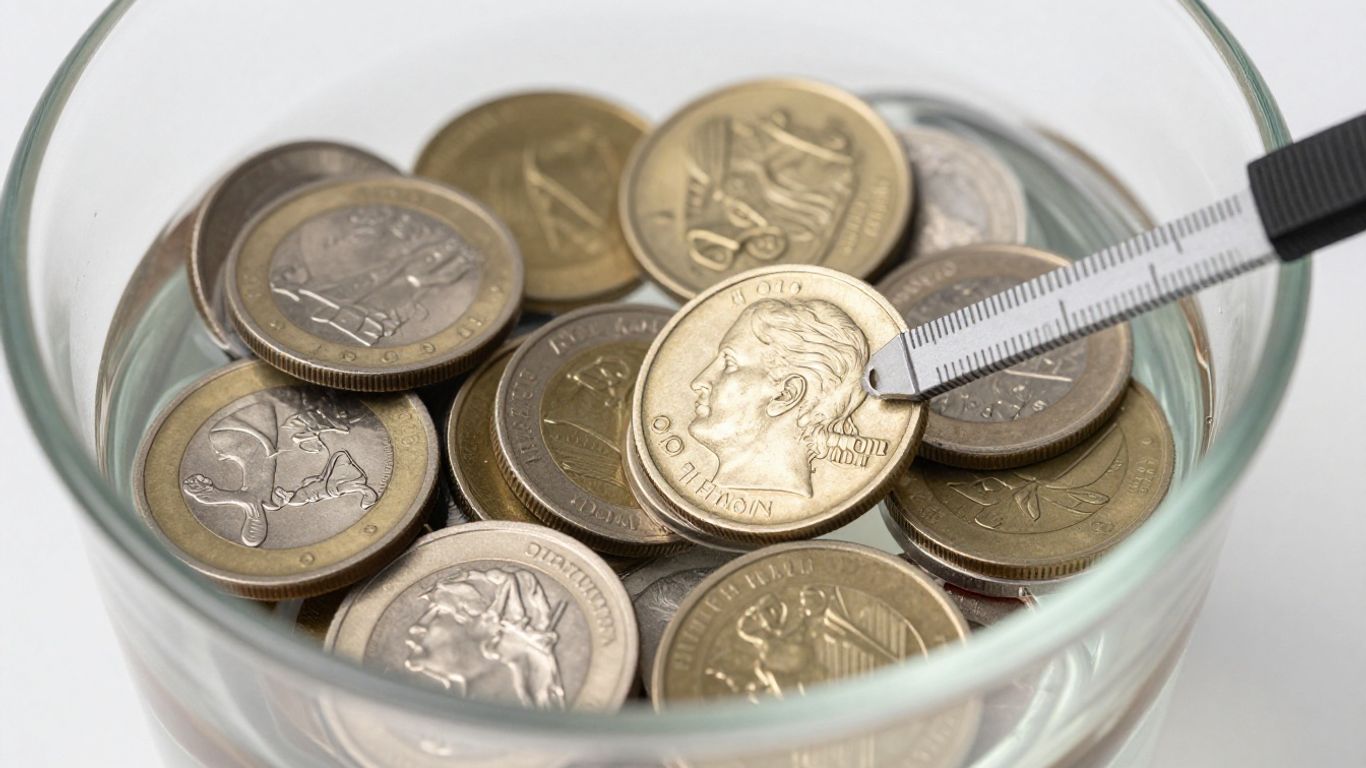
When you’re trying to figure out if a coin is the real deal, its density is a big clue. It’s basically how much ‘stuff’ is packed into a certain amount of space. For coins, this is super important because different metals have different densities. Think about it: a coin made of lead will feel heavier for its size than one made of aluminum, right? That’s density at play.
The Archimedes Principle in Practice
So, how do we actually measure this density, especially for coins? A lot of it comes down to a principle discovered ages ago by Archimedes. Basically, when you put an object in water, it pushes some water out of the way – that’s displacement. The amount of water it pushes out tells you the coin’s volume. By weighing the coin in air and then weighing it again while it’s submerged in water, you can figure out its density. It’s a neat trick that lets us measure volume without needing fancy tools like calipers for every single measurement, though those can help too. This method is a cornerstone for specific gravity testing protocol.
Defining Density for Coin Verification
Density is calculated by dividing a coin’s mass (its weight) by its volume. For coins, this value is pretty specific for each metal or alloy. For example, pure gold has a density of about 19.32 grams per cubic centimeter (g/cm³), while pure silver is around 10.49 g/cm³. If a coin you’re testing comes out with a density that’s way off these numbers, it’s a red flag. It might be made of a different metal, have a core of something cheaper, or even be hollow. This is why density checks are a go-to for spotting fakes.
Importance of Accurate Coin Density Measurements Testing
Why bother with all this? Well, accuracy matters a lot, especially when dealing with valuable coins or precious metals. A small error in measurement could lead you to believe a fake coin is genuine, or vice versa. This can cost you money, whether you’re a collector, a dealer, or a bank. Getting the density right helps confirm authenticity, check for tampering, and even assess the quality of the metal used. It’s a straightforward, yet powerful, way to verify what you’ve got.
- Weight Check: Use a precise digital scale. Even a slight deviation from the official weight can indicate a problem.
- Dimension Check: Calipers can measure diameter and thickness. These dimensions, along with weight, let you calculate volume.
- Water Displacement: Submerging the coin to find its volume is key. Make sure there are no air bubbles clinging to it!
Getting the density right helps confirm authenticity, check for tampering, and even assess the quality of the metal used. It’s a straightforward, yet powerful, way to verify what you’ve got.
Essential Equipment for Coin Density Measurements Testing
To get accurate density readings for coins, you’ll need a few key pieces of gear. It’s not just about having a scale; you need tools that can measure both weight and volume precisely. Think of it like baking – you need the right measuring cups and spoons, not just a big bowl.
Precision Digital Scales
This is your starting point. You need a scale that’s sensitive enough to pick up even tiny differences in weight. For most coin work, a scale with a readability of 0.01 grams is usually good. If you’re dealing with very small or thin coins, you might even want something that goes down to 0.001 grams. The accuracy of your weight measurement directly impacts the final density calculation. Make sure the scale is on a stable, level surface, away from drafts, to avoid skewed readings. It’s also a good idea to calibrate it regularly using known weights.
Calipers for Dimensional Accuracy
While density is often found using water displacement, sometimes you might need to measure a coin’s dimensions directly, especially if you’re trying to calculate volume geometrically for comparison or as a cross-check. Good quality digital calipers are perfect for this. They let you measure the diameter and thickness of a coin with high precision. This can be helpful for identifying coins that might have been altered or are not standard issue. You can find these at most hardware stores or online.
Hydrostatic Weighing Apparatus
This is where things get a bit more specialized. A hydrostatic weighing setup is designed specifically for density measurements using the Archimedes principle. It typically involves a precision scale mounted above a water bath, with a hook or platform that allows you to weigh an object both in air and submerged in water. Some advanced setups might include a built-in water bath with temperature control. This method is quite reliable for determining the density of solid objects like coins. You can find dedicated density measurement apparatus that integrate these features, making the process more streamlined. For example, some devices are built to measure gold purity and density using this very method, which is a good way to authenticate precious metals. Discover straightforward methods to authenticate gold coins.
Temperature Compensation Sensors
Water density changes with temperature. If you’re aiming for high accuracy, you need to account for this. A temperature sensor, often a digital thermometer or a probe connected to your weighing system, allows you to measure the water’s temperature accurately. Some advanced hydrostatic weighing systems have automatic temperature compensation built-in, which simplifies the process significantly. This means the equipment can adjust the density calculation based on the measured water temperature, removing a common source of error. Without this, you’d have to manually look up water density values for your specific temperature, which is prone to mistakes.
Conducting Coin Density Measurements Testing
Getting the density of a coin right is pretty straightforward once you know the steps. It’s all about measuring its weight and then figuring out its volume. The most common way to do this uses the old Archimedes principle – you know, the whole ‘Eureka!’ moment.
Step-by-Step Weighing Procedure
First things first, you need to get an accurate weight of the coin. This is where your precision digital scale comes in. Make sure it’s calibrated and on a level surface. Weigh the coin in the air first. Record this weight; let’s call it ‘W_air’.
Calculating Volume Through Displacement
Now for the tricky part: finding the volume. We do this by seeing how much water the coin pushes out of the way. You’ll need a container of water, preferably one with markings or a spout so you can measure the water volume accurately. A hydrostatic weighing apparatus is ideal here.
- Fill a container with distilled water to a consistent level. Note the initial water level or volume.
- Suspend the coin using a thin, strong thread (like fishing line) so it hangs just above the water. Weigh it again while it’s suspended like this, but not touching the water. This accounts for the weight of the thread in the water later.
- Carefully lower the coin into the water until it is fully submerged but not touching the sides or bottom of the container. Record the new weight. This is ‘W_water’.
- The difference between the weight in air and the weight in water (W_air – W_water) is directly related to the weight of the water displaced. Since the density of water is approximately 1 gram per cubic centimeter (g/cm³) at standard temperature and pressure, the weight difference in grams is numerically equal to the volume of the coin in cubic centimeters (cm³).
Interpreting Density Results
Once you have the weight in air (W_air) and the volume (V, which is equal to W_air – W_water in grams/cm³), calculating density is simple. The formula is:
Density (ρ) = Mass (m) / Volume (V)
So, in our case:
Density = W_air / (W_air – W_water)
The resulting density value is a key indicator of the coin’s material composition. Compare this calculated density to known values for the specific metal or alloy the coin is supposed to be made from. Significant deviations can suggest a counterfeit or a different alloy than expected.
Be mindful of temperature. Water density changes slightly with temperature, which can affect your results. Using a temperature compensation sensor or noting the water temperature and adjusting accordingly will improve accuracy.
Advanced Techniques for Coin Density Measurements Testing
Utilizing Density Measurement Apparatus
Beyond basic water displacement, specialized density measurement apparatus offers a more refined approach. These systems often integrate precision scales with sophisticated fluid handling and temperature control. For instance, some units employ a closed-loop system where the coin is submerged in a liquid, and the apparatus precisely measures the displaced volume and the coin’s weight. This method minimizes errors associated with manual water level readings and temperature fluctuations. Many of these devices come with built-in software that automatically calculates density, often providing results in grams per cubic centimeter (g/cm³). They can also be programmed with known densities of various metals, allowing for quick comparison and identification.
Integrating Purity and Density Analysis
For high-value items like precious metal coins, density testing is often combined with purity analysis. Advanced techniques can assess both properties simultaneously or in rapid succession. For example, some X-ray fluorescence (XRF) analyzers, while primarily for surface elemental composition, can be paired with density measurement modules. Similarly, some hydrostatic weighing systems are designed to not only determine density but also to infer purity based on slight variations from expected density values for pure metals. This dual approach provides a more robust verification, as a coin could have the correct density but be plated, or the correct elemental composition but be alloyed with a denser or less dense metal.
High-Capacity Measurement Solutions
When dealing with large quantities of coins or very large denomination coins, standard laboratory equipment might not suffice. Specialized high-capacity density measurement systems are available. These might involve larger tanks for hydrostatic weighing, more robust scales capable of handling kilograms, and automated systems for moving and submerging multiple items. For example, some systems are designed to test gold bars weighing over a kilogram, using the buoyancy method but scaled up significantly. These solutions are often found in mints, large refineries, or major financial institutions where bulk verification is a daily requirement. They streamline the process for high-volume operations, maintaining accuracy even with larger sample sizes.
Factors Influencing Coin Density Measurements Testing Accuracy
When you’re trying to figure out the density of a coin, a few things can throw off your numbers. It’s not always as straightforward as just weighing it and dunking it in water. You’ve got to pay attention to the details.
Water Temperature Effects
Water temperature is a big one. Water expands and contracts with heat, just like most things. This means the volume of a set amount of water changes depending on how warm or cold it is. Since you’re using water displacement to find the coin’s volume, any change in water volume directly affects your density calculation. Even a few degrees can make a noticeable difference in your final density reading. It’s why many professional setups have temperature sensors that automatically adjust the calculation. For instance, a change from 20°C to 25°C can alter the density of water enough to impact precise measurements.
Air Bubble Contamination
This is a sneaky one. When you submerge a coin, especially one with nooks and crannies, tiny air bubbles can get trapped on its surface. These bubbles add extra volume that isn’t actually part of the coin. More volume means a lower calculated density, which can lead you to think the coin is made of a lighter material than it is. Getting rid of these bubbles, perhaps by gently tapping the coin or using a fine brush, is pretty important for accurate results. It’s a common issue when using the buoyancy method for precious metals.
Sample Surface Condition
The surface of the coin itself matters. If it’s covered in dirt, oil, or any other gunk, that adds weight and can also affect how water interacts with the surface, potentially trapping more air. A clean coin gives you a much better reading. Sometimes, even minor surface irregularities or corrosion can subtly change the coin’s effective volume when submerged. Making sure your coin is clean and dry before weighing it in air is a good first step.
Here’s a quick rundown of what to watch out for:
- Temperature: Keep an eye on the water temperature. Aim for consistency.
- Bubbles: Be vigilant about trapped air. A gentle poke or brush can help.
- Cleanliness: A clean coin surface leads to cleaner data.
Sometimes, the simplest methods are the most sensitive to environmental factors. Paying attention to these small details can make the difference between a good measurement and a misleading one.
Non-Destructive Coin Density Measurements Testing Methods
When you need to check if a coin is the real deal without damaging it, there are a few ways to go about it. These methods focus on figuring out the coin’s density, which is a pretty solid indicator of its authenticity. It’s all about seeing if the coin’s physical properties match what they should be for its stated metal content.
Buoyancy Method for Precious Metals
The buoyancy method, often called the Archimedes principle in action, is a go-to for checking precious metals. It works by measuring how much water a coin displaces when submerged. You’ll need a precise scale and a way to suspend the coin in water. First, you weigh the coin in the air. Then, you weigh it again while it’s fully submerged in water. The difference in weight, combined with the density of water, lets you calculate the coin’s volume. From there, you can easily figure out its density (mass divided by volume). This density value is a key fingerprint for a coin’s metal composition.
Here’s a quick rundown of the steps:
- Weigh the coin in air (this is your dry weight).
- Suspend the coin in distilled water and record its weight (this is your wet weight).
- Calculate the volume of water displaced using the difference between the dry and wet weights.
- Determine the coin’s density using the formula: Density = Dry Weight / (Dry Weight – Wet Weight).
Specific Gravity Testing Protocol
Specific gravity is essentially the ratio of a substance’s density to the density of water. For coins, this test is a direct application of the buoyancy method. It’s a scientific way to verify density without causing any harm to the coin. Different metals have very specific specific gravity values, and if your coin’s calculated value doesn’t line up, it’s a red flag.
Here’s a typical protocol:
- Step 1: Air Weighing. Use a high-precision scale to get the coin’s weight in air. Let’s call this ‘A’.
- Step 2: Water Weighing. Suspend the coin in distilled water (making sure it’s fully submerged and not touching the sides or bottom of the container) and weigh it. Let’s call this ‘B’.
- Step 3: Calculation. The specific gravity is calculated as: Specific Gravity = A / (A – B).
- Step 4: Comparison. Compare the calculated specific gravity to known values for pure metals. For example, pure gold has a specific gravity of about 19.32, and pure silver is around 10.49.
Electronic Verifiers for Bulk Properties
Beyond simple water displacement, there are electronic devices that can assess a coin’s bulk properties without touching it or requiring water. These often use electromagnetic principles. Devices like Sigma Metalytics verifiers, for instance, can scan a coin and analyze its electromagnetic response. This allows them to detect variations in metal composition, including different alloys or the presence of core materials like tungsten, which can be used in sophisticated counterfeits. These tools are great for quickly screening a large number of coins, offering a non-destructive way to check for anomalies.
These electronic tools are designed to look beneath the surface, going beyond what simple visual inspection or basic tests can reveal. They work by interacting with the metal’s electrical conductivity and magnetic properties, providing a reading that can be compared against a database of known genuine coins. It’s a modern approach to an age-old problem of authentication.
Interpreting Coin Density Measurements Testing Data
So, you’ve gone through the steps, weighed your coin in air, weighed it submerged, and maybe even used some fancy equipment. Now what? It’s time to make sense of the numbers you’ve got. This is where the real detective work begins.
Comparing Results to Known Standards
Every coin, especially those made of precious metals or official currency, has a known density. Think of it like a fingerprint. For example, pure gold has a density of about 19.32 g/cm³, while pure silver is around 10.49 g/cm³. When you calculate the density of your coin, you’ll want to compare it against these established values. If your coin’s calculated density is significantly off, it’s a big red flag.
Here’s a quick look at some common densities:
| Metal | Density (g/cm³) |
|---|---|
| Pure Gold | 19.32 |
| Pure Silver | 10.49 |
| Pure Copper | 8.96 |
| Pure Platinum | 21.45 |
The closer your coin’s density is to the standard, the more likely it is genuine. Slight variations can occur due to alloys or minor manufacturing differences, but large discrepancies point to a problem.
Identifying Anomalies and Fakes
Density testing is a powerful tool for spotting counterfeits. A coin that’s supposed to be solid gold but has a density much lower than 19.32 g/cm³ might be hollow, plated, or made from a cheaper metal. Conversely, a density that’s too high could indicate the presence of denser, more expensive metals mixed in, or perhaps a different composition altogether. Sometimes, fakes are made by using a core of a cheaper metal, like tungsten, which has a density close to gold (19.25 g/cm³). While density alone might not catch these, it’s a strong indicator that further investigation is needed. You’re looking for anything that doesn’t quite add up.
Cross-Referencing with Other Verification Methods
While density is a great metric, it’s rarely the only test you should perform. Think of it as one piece of a larger puzzle. Combining density results with other verification techniques gives you a much more reliable picture. For instance, if a coin has the correct density but fails a simple magnet test (if it’s supposed to be non-magnetic), that’s suspicious. Similarly, XRF analysis can confirm the surface composition, and visual inspection can reveal minting errors or inconsistencies. Using multiple methods helps to confirm authenticity and catch sophisticated fakes that might fool a single test. It’s all about building a strong case for authenticity. For more on distribution analysis in testing, you can look into mathematical methods.
When interpreting density data, always consider the coin’s intended composition and any known variations. A single outlier might be an error, but a pattern of deviations suggests a systematic issue with the coin or the testing process itself. Always double-check your calculations and equipment calibration before concluding.
Applications of Coin Density Measurements Testing
Density testing isn’t just for hobbyists; it’s a serious tool used in a few different fields. When you need to know for sure what something is made of, especially if it’s valuable, density is a big clue.
Jewelry Industry Standards
In the jewelry world, knowing the exact composition of metals is super important. Density helps jewelers confirm they’re working with the right karat of gold or the correct alloy for platinum. It’s a quick way to check if a piece is what it claims to be, without having to melt it down. This is especially true for custom pieces or when buying scrap gold. Accurate density measurements help maintain the integrity and value of precious metal items.
- Verifying gold purity (e.g., 10K, 14K, 18K, 24K)
- Identifying platinum and palladium alloys
- Detecting common base metal fakes
- Assessing the quality of gemstones (though less common for density alone)
Density testing provides a non-destructive way to get a lot of information about a metal’s composition. It’s a practical step for quality control in manufacturing and for appraising items.
Banking and Financial Institutions
Banks and places that deal with a lot of precious metals, like pawn shops or bullion dealers, use density testing to verify the authenticity and purity of coins and bars. This is a critical step in preventing fraud and ensuring that the assets they hold or trade are genuine. Imagine a bank accepting a large gold bar – they’d want to be absolutely sure it’s pure gold and not a clever fake filled with a cheaper metal.
Here’s a look at how density testing fits in:
| Item Type | Typical Density (g/cm³) | Purpose of Density Test |
|---|---|---|
| Gold Coin (24K) | 19.32 | Authenticity verification, fraud detection |
| Silver Coin (999) | 10.49 | Purity confirmation, weight-to-volume check |
| Platinum Bar | 21.45 | Alloy identification, value assessment |
Research and Development Laboratories
In R&D, density measurements are used for all sorts of materials, not just precious metals. Scientists might use density to:
- Characterize new alloys or compounds.
- Determine the porosity of materials.
- Check for consistency in manufactured batches.
- Understand material properties for specific applications, like in aerospace or electronics.
For example, if a lab is developing a new lightweight but strong material, density would be one of the key properties they’d measure and track. It’s a basic but very informative physical property.
Troubleshooting Common Issues in Coin Density Measurements Testing
Even with the best equipment, sometimes things just don’t add up when you’re measuring coin density. It’s pretty common to run into a few snags. Let’s talk about what might be going wrong and how to fix it.
Addressing Inconsistent Readings
Getting different numbers every time you weigh a coin can be frustrating. Often, this points to a few simple things. First, check if your scale is on a stable, level surface. Even a slight wobble can throw off readings. Also, make sure you’re not bumping the scale or the setup while it’s weighing. Air currents can also play a role, especially with lighter coins or sensitive scales. Consider using a draft shield if you have one.
Here are some common culprits for inconsistent readings:
- Scale Stability: Ensure the scale is on a solid, vibration-free surface.
- Environmental Factors: Drafts, humidity, and temperature changes can affect measurements.
- User Error: Inconsistent handling of the coin or weighing apparatus.
- Equipment Drift: Scales can lose calibration over time.
Ensuring Equipment Calibration
This is a big one. If your equipment isn’t calibrated, your results won’t be reliable, plain and simple. Scales need to be checked regularly with known weights. Most scales have a calibration function; you just need to follow the manufacturer’s instructions. For hydrostatic weighing, the accuracy of your thermometer and the volume of your displacement container also matter. If you’re using a specialized density meter, consult its manual for calibration procedures.
Regular calibration is the bedrock of accurate density measurements.
Handling Irregularly Shaped Coins
Most coins are pretty uniform, but sometimes you get older ones or special issues that aren’t perfectly flat or round. This can make calculating volume tricky. For these, you might need to be a bit more creative with your displacement method. Instead of just submerging the coin, you might need to use a fine wire or a small basket to hold it completely underwater without adding significant extra volume. The key is to ensure the coin is fully submerged and that any added material (like the wire) is accounted for or is negligible.
When dealing with odd shapes, the goal is to accurately measure the actual volume the coin displaces. This means ensuring it’s fully submerged and that any suspension system doesn’t interfere with the water level or add significant volume itself. Precision here is key to getting a correct density figure.
Sometimes, if a coin is extremely irregular, you might have to resort to measuring its dimensions with calipers and approximating its volume using geometric formulas, though this is less accurate than water displacement. For very valuable or rare irregular coins, non-destructive methods that don’t rely on perfect submersion might be a better choice.
The Role of Technology in Coin Density Measurements Testing
Technology has really changed how we measure coin density, making things faster and more precise. Gone are the days of just eyeballing it or using clunky old tools. Modern tech brings a whole new level of accuracy to the table.
Digital Interfaces for Data Transfer
One of the biggest game-changers is how easily we can now move data around. Many new density measurement devices come with built-in ports, like USB or RS-232. This means you can hook them right up to a computer or a dedicated data logger.
- Record keeping becomes a breeze. No more scribbling numbers in a notebook that might get lost or smudged.
- Analysis is way simpler. You can export your findings directly into spreadsheets or specialized software for deeper dives.
- Consistency is improved. Having digital records helps track changes over time or compare results from different testing sessions.
This connectivity is super important for anyone doing serious testing, whether it’s for quality control in a mint or for research.
Automated Temperature Compensation
Water temperature can mess with density readings, which is a real pain. Luckily, technology has stepped in here too. Many advanced hydrostatic weighing systems now include sensors that automatically measure the water’s temperature. The device then uses this information to adjust the density calculation on the fly.
This automatic adjustment takes a lot of the guesswork out of the process. It means you don’t have to constantly monitor a separate thermometer and manually input corrections, which saves time and cuts down on potential human error. It’s a small feature, but it makes a big difference in getting reliable numbers.
Streamlining the Testing Workflow
Beyond just data transfer and temperature control, technology is making the whole process of density testing much smoother. Some devices are designed with user-friendly interfaces that guide you through the steps. Others combine multiple functions, like weighing and volume calculation, into a single unit. This integration means fewer separate pieces of equipment to manage and a more efficient workflow overall. For example, some modern testers can perform a density measurement and purity analysis in just a couple of quick steps, cutting down testing time significantly. This is a huge plus when you’re dealing with a large volume of coins or precious metal samples.
Wrapping Up Your Coin Density Testing
So, we’ve gone over a bunch of ways to figure out what your coins are really made of, focusing on density. It’s not always super simple, and some methods are way more involved than others. Whether you’re just curious about a few coins or need to be really sure for business, picking the right tool matters. We looked at everything from basic water displacement to more high-tech gear. Remember, the goal is to get a good, honest reading without messing up your coins. Keep practicing with these methods, and you’ll get better at spotting what’s real and what’s not. Happy testing!
Frequently Asked Questions
What is density and why is it important for checking coins?
Density is like how much ‘stuff’ is packed into a certain amount of space. For coins, knowing its density helps tell if it’s real. If a coin has the wrong density, it might be fake or made of a different metal than it should be.
What's the easiest way to measure a coin's density at home?
A common way is using the water displacement method, which is part of the Archimedes Principle. You weigh the coin in the air, then weigh it again while it’s underwater. Using these weights, you can figure out the coin’s volume and then its density.
Do I need special tools to measure coin density?
For a good measurement, you’ll need a precise digital scale that can measure in grams very accurately, and a way to measure the coin’s dimensions, like calipers. For the water method, you’ll also need a container of water and a way to suspend the coin.
Can temperature affect density measurements?
Yes, it can! Water expands or shrinks a little with temperature changes. This can slightly change the volume measurement, which then affects the density calculation. Using a temperature sensor helps correct for this.
What if I get different density results each time I test the same coin?
Inconsistent results can happen. Make sure your scale is properly calibrated, that there are no air bubbles stuck to the coin when you weigh it underwater, and that the coin’s surface is clean. Also, check that your water temperature is stable.
Are there ways to test coin density without getting the coin wet?
Some advanced electronic testers can measure properties related to density without using water. These often work by sending signals through the metal. However, the water displacement method is a very reliable and common non-wetting technique.
How do I know what the correct density for a coin should be?
You need to compare your results to known standards. Official mints or reputable sources provide the exact weight, dimensions, and density for genuine coins. If your coin’s measured density is significantly different, it’s a red flag.
Can density testing alone prove a coin is fake?
Density testing is a very strong indicator, but it’s best used with other methods. For example, a coin might have the correct density but be plated, or a fake might use a mix of metals to get close to the right density. Combining tests gives the most reliable results.